Efficient Protein Powder Mixing in Manufacturing: A Complete Guide to Mixers
As consumers increasingly prioritize fitness, nutrition, and healthy lifestyles, global demand for protein powder continues to grow rapidly. From whey protein supplements and plant-based protein powders to meal replacement products, manufacturers face a common challenge: how to achieve uniform ingredient blending while simultaneously ensuring product quality and production efficiency.
A professional protein powder mixer plays a crucial role in ensuring every batch meets strict standards for consistency, taste, nutritional value, and safety.
What Is Protein Powder Mixing?
Protein powder mixing is the process of combining multiple dry ingredients into a uniform blend.
Typical ingredients include:
- Whey Protein Concentrate
- Whey Protein Isolate
- Soy Protein
- Pea Protein
- Rice Protein
- Cocoa Powder
- Flavorings
- Sweeteners
- Vitamins
- Functional Nutrients
The objective is to ensure that every scoop of finished product contains the same nutritional profile and flavor distribution.
Without proper mixing equipment, ingredient segregation can occur, leading to inconsistent product quality.
Best Protein Powder Mixers for Industrial Production
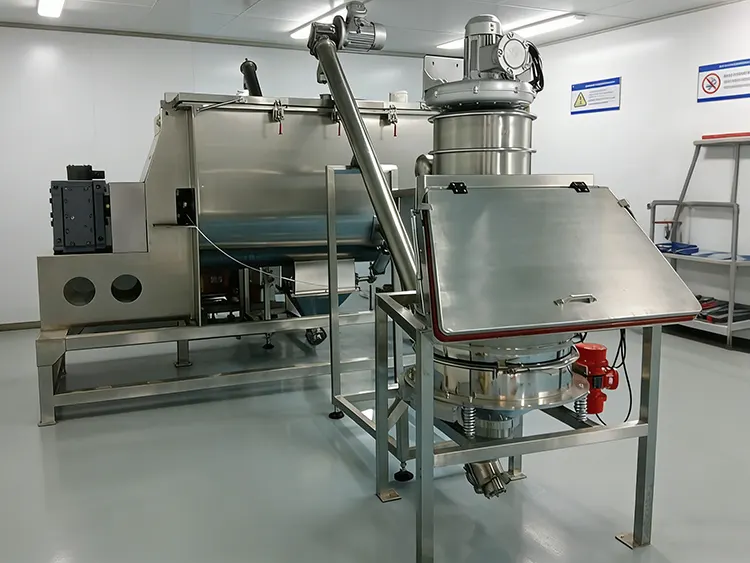
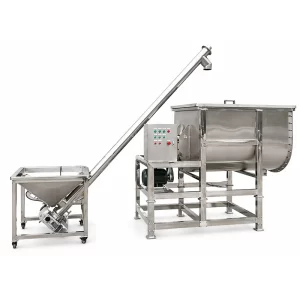
The Ribbon Blender is the most popular solution for protein powder production.
How It Works
The mixer uses inner and outer helical ribbons mounted on a central shaft. The outer ribbon moves materials toward the center while the inner ribbon pushes materials outward. This continuous counterflow creates rapid and uniform mixing.
Advantages
- Exceptional Mixing Uniformity: Through the convective motion of dual inner and outer helical ribbons, three-dimensional mixing is achieved; mixing uniformity typically reaches 96%–99%, making it capable of handling high mixing ratios of up to 1:10,000
- Gentle, Low-Shear Mixing: Preserving Protein Activity. The helical ribbon operates at a low speed, generating no significant heat rise, thereby preventing damage to heat-sensitive proteins, probiotics, or flavor compounds..
- Compatible with a Wide Range of Powders and Trace Liquids: Whether handling free-flowing powders (such as whey protein) or powders prone to agglomeration and significant density variations (such as soy protein or cocoa powder), effective mixing is ensured. Additionally, a spray device allows for the incorporation of small quantities of oils, flavorings, or lecithin.
- Hygienic Design: Compliant with GMP Requirements. The interior walls of the equipment can be mirror-polished, ensuring no dead corners and zero residue. Constructed from 304/316L stainless steel, the materials meet the hygiene standards for food, health supplements, and pharmaceuticals.
- Wide Batch Processing Range and High Efficiency: With capacities ranging from 10 to 5,000 liters and a filling volume of 40%–70%, a single batch can mix anywhere from hundreds of kilograms to several tons of protein powder, with a typical mixing time of just 5 to 15 minutes.
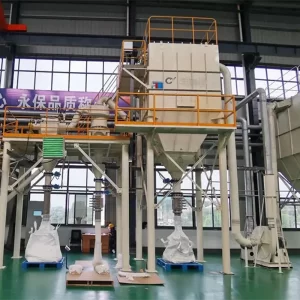
Complete Protein Powder Production Line
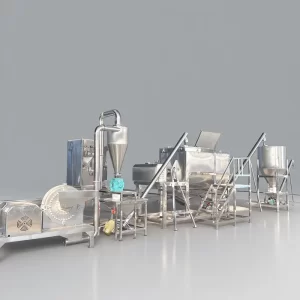
A modern protein powder production line typically includes:
Raw Material Handling
Ingredients are delivered through:
- Bag dumping stations
- Jumbo bag unloading systems
- Bulk storage silos
Vacuum Conveying
Vacuum conveying systems transport ingredients without generating excessive dust.
Benefits:
- Cleaner production
- Reduced contamination
- Lower labor requirements
Mixing Unit
The ribbon blender serves as the central mixing unit.
Screening
After mixing, powders pass through a vibratory screener to remove agglomerates.
Packaging
Automated packaging systems provide:
- Accurate filling
- Reduced labor costs
- Higher throughput
Frequently Asked Questions
What is the best mixer for protein powder?
Ribbon blenders are widely regarded as the most efficient and cost-effective solution for protein powder production.
How long does protein powder mixing take?
Most industrial batches require 5–15 minutes depending on formulation and batch size.
Can liquids be added during mixing?
Yes. Oil, flavoring, and other liquid ingredients can be sprayed directly into the mixer.
How can I prevent dust during protein powder production?
Implementing vacuum conveying systems and enclosed mixing equipment significantly reduces dust generation.
What mixing uniformity can be achieved?
Modern SATURN mixers typically achieve mixing uniformity above 99%.
 Powder Mixer